
What Cupping Marks Really Mean |
Wollongong Massage Expert Explains
One of the first things people ask me after a cupping session is:
“Are those bruises?”
Short answer?
No.
They might look like bruises. They’re round. They can be red, purple or dark pink. But physiologically, they are not the same thing.
And understanding that difference changes how you see cupping altogether.

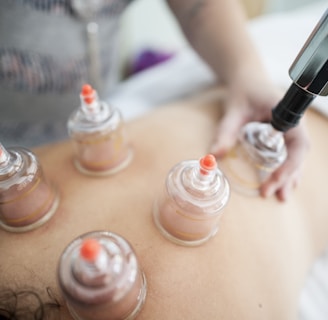
What a Bruise Actually Is
A true bruise is caused by blunt force trauma.
You hit something. Something hits you. Capillaries rupture due to impact. Blood leaks into surrounding tissue. The area becomes tender because damage occurred.
Bruising = tissue trauma.
Cupping is different.
There is no impact. No blunt force. No tearing. No collision.
Instead of force driving down into tissue… cupping gently lifts tissue upward.
That difference matters.
What Cupping Actually Does
Most manual therapy compresses.
Hands press downward. Elbows apply pressure. Tools push into muscle.
Cupping does the opposite.
It creates negative pressure — a vacuum effect — that lifts skin and superficial fascia slightly away from the underlying structures.
That decompression:
Increases local circulation
Encourages lymphatic movement
Separates adhered fascial layers
Reduces stagnation
Improves tissue glide
The marks that appear are a surface-level response to that increased circulation and fluid movement — not deep muscle damage.
So What Do the Marks Represent?
Think of them as a temporary window into local circulation.
Areas that show darker colouring often indicate:
Local congestion
Slower circulation
Tissue density
Chronic tension patterns
Lighter pink areas typically suggest healthier blood flow and less stagnation.
The colour variation doesn’t mean “worse injury.”
It reflects how that particular area has been functioning.
Sometimes someone will have one side darker than the other. That often aligns with dominant side loading, posture, training patterns or previous injury.
Your body leaves clues.
Cupping just makes them visible.
Does Cupping Hurt?
This is the practical question everyone wants answered.
Realistically, most cupping marks fade within:
3 to 10 days.
In some cases:
Light marks may fade within 48 hours.
Darker areas can take up to 7–10 days.
It depends on:
Your circulation
Hydration
Metabolic rate
How congested the area was
How strong the suction was
How long the cups were left on
Healthier tissue with good circulation clears faster.
People who recover well from training usually clear marks quicker too.
How Long Before a Special Event?
If you have:
A wedding
A photoshoot
A beach holiday
A competition
An event where skin will be visible
I recommend allowing at least 14+ days buffer before the event.
That gives your body time to fully clear any visible marks, even if you tend to mark darker.
If you’re unsure how your body responds, book your first cupping session well ahead of important events so you can see how quickly you fade.
Planning removes stress.
Why Some People Mark More Than Others
This isn’t about toughness.
It’s about physiology.
Factors that influence marking include:
Hydration levels
Hormonal fluctuations
Circulation quality
Stress levels
Training load
Previous injury sites
High-stress individuals often mark darker because their nervous system holds more chronic tension.
Desk workers can mark just as much as athletes.
It’s not about fitness level — it’s about tissue condition.
Should You Avoid Cupping Because of Marks?
What Happens Under the Surface
The visible marks fade quickly.
The internal effect lasts longer.
Cupping can:
Improve range of motion
Reduce fascial stiffness
Support recovery
Encourage parasympathetic activation
Improve tissue hydration
Many clients notice they move more freely immediately after.
The mark is temporary.
The movement benefit is the goal.
The Bigger Perspective
We’re conditioned to associate colour change with injury.
But not all colour changes are damage.
Cupping marks are more like a temporary circulation map.
They’re evidence of change — not harm.
And they’re reversible.
Your body is constantly clearing, adapting and restoring balance.