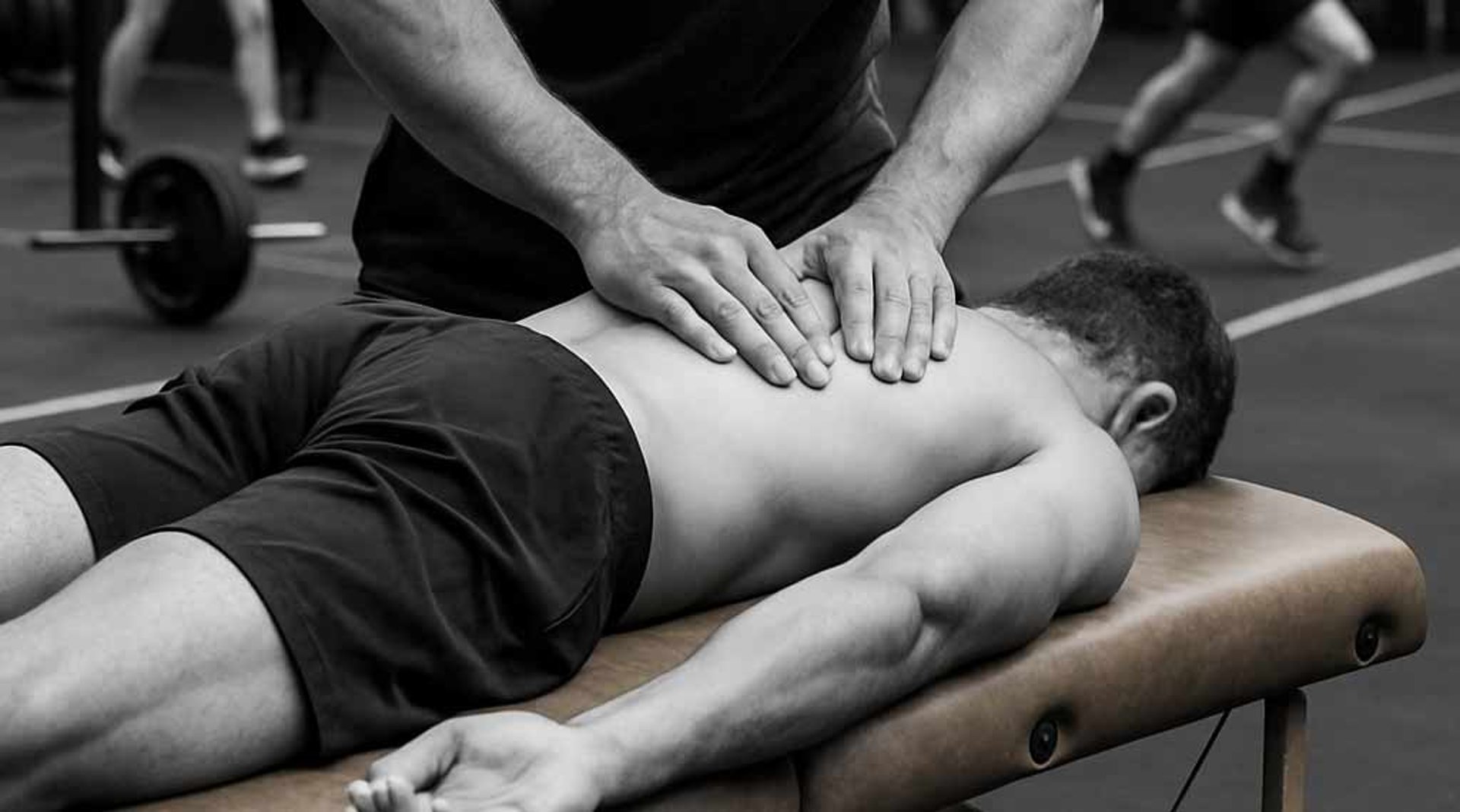
CrossFit Recovery: Why Stretching Alone Isn’t Enough
If you train CrossFit, you probably stretch.
You foam roll.
You might even sit on a lacrosse ball wondering why everything still feels tight.
As a remedial massage therapist, sports therapist, and dry needling practitioner at Advance Body Massage in Wollongong, I work with a lot of CrossFit athletes — and this is one of the biggest misconceptions I see:
Stretching alone isn’t recovery.
It’s a tool. A useful one.
But it’s not the whole picture — and for many CrossFitters, it’s the reason pain keeps coming back.


Need a massage?
You can book directly with me
at my Wollongong clinic
Home > Massage Blog > CrossFit Recovery
Why CrossFit Bodies Feel “Tight” All the Time
CrossFit places unique demands on the body:
High intensity
Heavy loads
Repetitive movement patterns
Fatigue under speed and volume
That combination doesn’t just shorten muscles — it overloads tissue.
When a muscle is:
Overworked
Constantly bracing
Compensating for weakness elsewhere
…it doesn’t respond well to stretching alone.
In fact, stretching a muscle that’s already overloaded or protecting the body can sometimes make things feel worse.
Stretching vs Recovery: They’re Not the Same Thing
Stretching helps with:
Temporary range of motion
Short-term relief
Warm-ups and cool-downs
What it doesn’t do well:
Release deep muscle tension
Address trigger points
Improve tissue quality
Reset an overloaded nervous system
Fix compensation patterns
That’s why many CrossFit athletes stretch daily…
…and still feel stiff, sore, or beat up.
The Most Common Muscle Issues I See in CrossFit Athletes
Working one-on-one with CrossFitters in Wollongong, there are clear patterns that show up again and again.
1. Shoulders & Upper Back
From overhead lifts, kipping, and pressing volume:
Tight lats and pecs
Overworked traps
Restricted shoulder movement
This often leads to shoulder pain, neck tension, or reduced overhead mobility.
2. Hips & Glutes
Heavy squats, Olympic lifts, and running can overload:
Hip flexors
Glutes
Deep hip stabilisers
When these don’t function properly, the lower back often takes over.
3. Lower Back
One of the most common complaints.
Often not because the back is “weak”, but because it’s doing too much work for other areas.
4. Forearms & Elbows
From gripping barbells, rings, and pull-ups:
Chronic forearm tightness
Elbow discomfort
Reduced recovery between sessions
These issues aren’t random — they’re predictable outcomes of high-volume, high-load training.
Why Massage Plays a Key Role in CrossFit Recovery
This is where remedial and sports massage fits in.
Massage works on:
Muscle tension
Fascia
Trigger points
Tissue hydration
Nervous system down-regulation
Instead of forcing length into tight tissue, massage helps:
Release overload
Improve tissue quality
Restore movement capacity
Support faster recovery between sessions
For CrossFit athletes, this often means:
Less stiffness after training
Better movement in lifts
Fewer flare-ups
Improved performance consistency
Recovery Is About Balance, Not Just Flexibility
One of the biggest mistakes I see is focusing only on flexibility, while ignoring:
Muscle imbalances
Weak links
Overactive stabilisers
Fatigue patterns
That’s why my approach at Advance Body Massage looks at the whole body, not just the sore spot.
Pain in one area is often the result of imbalance somewhere else — and unless that’s addressed, no amount of stretching will fix it long-term.
Why CrossFit Athletes Often Feel Better After Massage (Even When Stretching Didn’t Work)
Massage changes how the body responds to movement.
When muscles are:
Less guarded
Better hydrated
Neurologically calmer
Stretching, mobility work, and strength training suddenly work better.
This is why many CrossFit athletes tell me:
“I stretch all the time, but this is the first thing that’s actually helped.”
Massage doesn’t replace training — it supports it.
Recovery Is Part of Training (Not a Luxury)
CrossFit pushes capacity.
Recovery protects longevity.
Ignoring recovery doesn’t make you tougher — it just shortens how long you can train pain-free.
Whether you train a few times a week or are deep into high-volume programming, your recovery strategy matters just as much as your workouts.
Can Massage Be Its Own Category of Treatment? Absolutely.
One of the biggest myths is that massage is only a “supportive” therapy.
In reality:
Many pain conditions are primarily soft-tissue driven
Muscle tension can cause joint pain
Chronic pain often lives in fascia and trigger points
Stress and nervous system overload amplify symptoms
In these cases, massage therapy isn’t an add-on — it’s the main treatment.
When massage is:
Clinically applied
Assessment-based
Combined with corrective movement
Delivered by a qualified remedial therapist
…it stands confidently as its own category of healthcare, not underneath physiotherapy.
Final Thoughts
Stretching has its place.
So does foam rolling.
But if your body feels constantly tight, sore, or limited, that’s your system asking for something more.
At Advance Body Massage in Wollongong, I work one-on-one with CrossFit athletes to support recovery, balance the body, and help training feel sustainable — not just survivable.
Because the goal isn’t just to train hard this week.
It’s to keep training well long-term.
Train CrossFit?
Book a recovery massage with me @
Advance Body Massage
Wollongong.